
 Celiform
How to Design a Premium Unboxing Experience
The box is the first thing your customer holds, before the product itself. This guide walks through the unboxing moment by moment, the details that make it feel premium, and what to decide before you brief a packaging partner.

The Unboxing, Moment by Moment
An unboxing is a short sequence, and each step is a chance to confirm, or undermine, what the product costs.
1. The Box in the Hand
Before anything opens, the customer feels the weight of the box, the texture of the wrap and the edge of any finishing. A rigid box made from thick board already says that the contents are worth protecting.
2. Opening
The way a box opens sets the pace. A lift-off lid rises slowly as air escapes; a book-style lid swings open with a magnetic pull; a drawer slides out on a ribbon. Each is a small ritual, and none of them should need force or a knife.
3. The Reveal
The first view inside is where most packaging loses the moment. The product should sit in its own place, level and still, with nothing loose, rattling or tilted. A smooth insert face in a colour that belongs to the brand frames the product rather than competing with it.
4. Lifting the Product Out
The cavity should hold the product firmly but let it go easily: finger space at the side, a cavity just deep enough, or a ribbon underneath. A product that has to be pried out undoes the reveal.
5. Putting It Back
Many premium boxes are kept. A precise insert lets the product go back exactly where it came from and the lid close cleanly, so the box keeps working on a shelf or a dressing table long after the first opening.
Details That Make Packaging Feel Premium
- A precise fit. A cavity shaped to the product, so nothing moves in transit or when the box is tilted.
- A smooth insert. The insert is what the eye lands on first. A dense, smooth fibre surface reads as considered; cut foam can read as budget.
- Restraint in finishing. One or two finishes, used well, usually look more premium than every option at once: a foil-stamped logo on a soft-touch lid, or an embossed mark on a textured wrap.
- Colour that carries through. A box, insert and finish chosen together, so the inside feels as intentional as the outside.
- An order to the reveal. For a set, the hero product placed where the eye lands first, with accessories to the side or underneath.
- Something to feel. Embossing, debossing and textured papers reward touch as well as sight.
- A clean close. A lid that seats properly and a box that still closes neatly after the product has been taken out and put back.
Matching the Box Style to the Product
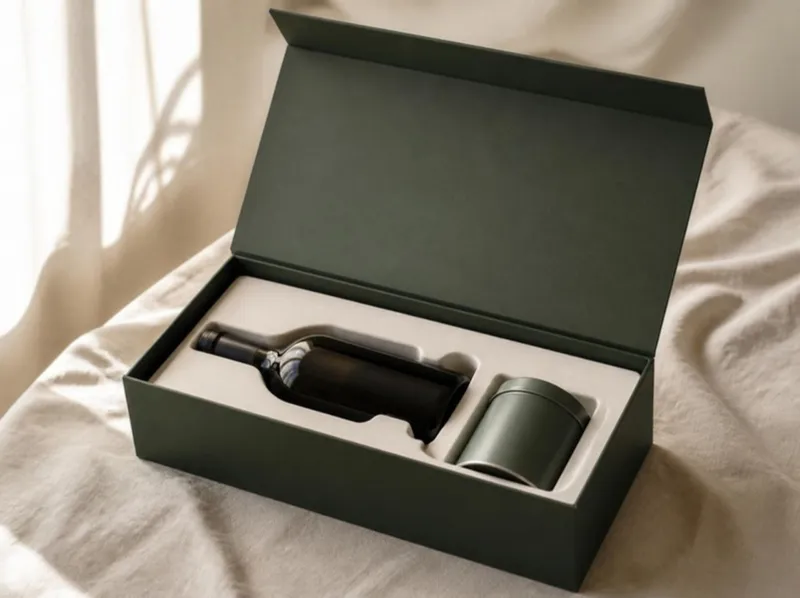
Book-style: opens like a cover.
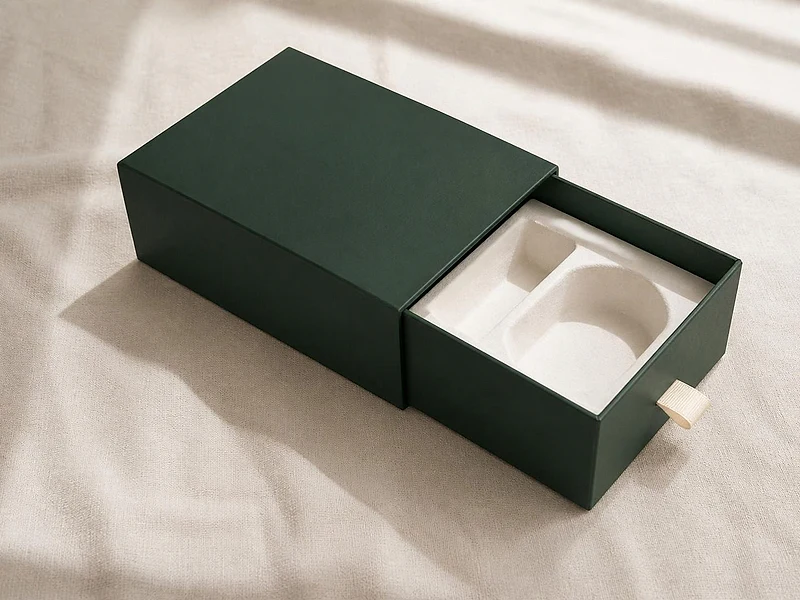
Drawer: slides out on a ribbon or tab.
There is no single right answer, but some pairings come up again and again:
- Fragrance, skincare and beauty sets often suit a lift-off lid, for the slow reveal, or a book-style box with a magnetic closure for a gift set.
- Electronics often suit a lift-off lid, with the device on top and cables or accessories in their own cavities.
- Jewellery and watches often suit a book-style box or a drawer, where the piece is presented at an angle the moment it opens.
- Wine, spirits and gourmet often suit a book-style box, with the bottle or tin held in its own primary pack.
- Corporate and festive gifting often suits a drawer or a book-style box, which can hold several items in one considered layout.
The box styles and finishes are shown on the Packaging page, and each category on the Industries page.
Common Mistakes
- Sizing the box before the product. The insert should be designed around the product first and the box around the insert, or the product ends up floating in a gap.
- A generic tray. A stock tray or a cut-out the product can move in makes an expensive product feel ordinary.
- Too many finishes. Foil, spot UV, embossing and a busy print on one lid compete with each other and with the product.
- Forgetting transit. Heavy glass and devices need to be held, not just placed. A precise fit is protection as well as presentation.
- A product that is hard to lift out. Without finger space or a ribbon, the reveal ends in a struggle.
- Leaving the inside to chance. The outside is designed with care and the inside is left to whatever fits. The customer sees both.
A Checklist Before You Brief
- Everything that goes in the box, with dimensions or a 3D file of each item.
- The order in which the customer should see and lift each item.
- The box style, or the feeling you want the opening to have.
- The colours of the wrap and the insert, and which finishes carry the brand.
- Whether the box will be kept, gifted or shipped on, which changes how it should close and travel.
- Quantity per run and your launch or shipment date.
For the materials inside the box, read the moulded pulp inserts guide; for the words used along the way, the packaging glossary.